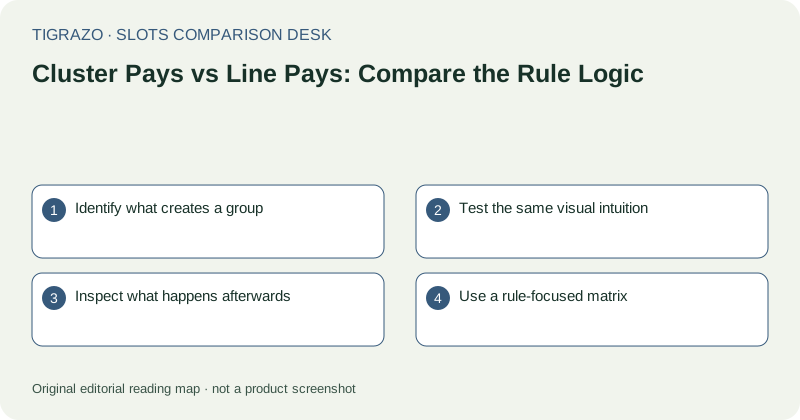
Identify what creates a group
In a cluster system, qualifying symbols form a connected group under a defined adjacency rule. Horizontal and vertical connections are common, but diagonal treatment and special-symbol behaviour require confirmation. The minimum group size is part of the rule, not something the word cluster supplies.
In a line system, positions belong to a predefined path across reels. Direction, starting position and consecutive count commonly matter. Symbols that look close on the screen may not share a qualifying line.
Test the same visual intuition
Hypothetical example: five A symbols form an L-shaped connected group. Under a rule requiring five orthogonally adjacent A symbols, the cluster qualifies. Under a separate line rule requiring matching symbols along a particular five-reel path, the same L shape does not establish any award.
Reverse the example: three A symbols lie along a drawn zigzag payline but do not touch as a connected group. They may satisfy a stated three-reel line rule while failing a cluster minimum. These examples compare definitions, not award frequency.
Inspect what happens afterwards
Cluster formats are often illustrated with removals and replacements, but cascades are not the defining difference and should not be assumed. A line-based game can also use cascading mechanics. Read follow-on behaviour as a separate feature dimension.
Likewise, neither format inherently guarantees a lower stake or a smoother result distribution. Symbol probabilities, award values and feature structures determine mathematical properties beyond the geometry of a match.
Use a rule-focused matrix
| Question | Cluster pays | Line pays |
|---|---|---|
| What connects symbols? | Defined adjacency | Specified path |
| What count matters? | Connected group size | Qualifying consecutive match |
| Do diagonals count? | Check adjacency rule | Only as path specifies |
| Are cascades automatic? | No assumption | No assumption |
Keep award bases alongside this matrix if numerical examples are added. A multiplier for a group and a multiplier for a line may refer to different stake units.
Decide which explanation is missing
If you cannot reproduce the cluster count, study its neighbour rule. If you cannot trace the line award, study its path and direction. A useful comparison points to the precise missing concept rather than issuing a best-format verdict.
- Is connectivity explicit?
- Is path direction explicit?
- Are wild exceptions documented?
- Are follow-on features evaluated separately?
Once those questions are answered, both formats become legible. That clarity is independent of whether either game's full mathematics is available or whether a reader decides to play at all.