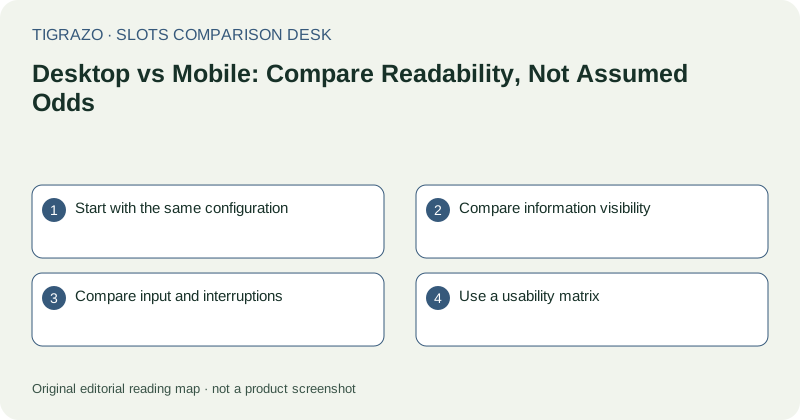
Start with the same configuration
Confirm the title, rule version, stake basis and any stated mathematical configuration on each device. If they match, a smaller screen is not evidence that the outcome model changes. If they differ, document the actual difference rather than attributing it automatically to device type.
Keep unknown configurations labelled unknown. A familiar logo or responsive layout does not prove equivalence, but an unfamiliar arrangement does not prove a mathematical disadvantage either.
Compare information visibility
On desktop, rules may appear in a larger panel; on mobile, they may require scrolling or nested menus. Check whether total stake, balance, feature conditions and decimal points remain legible in the intended orientation. More screen space is useful only if the information is well organised.
Hypothetical example: a mobile control truncates the label beside 0.20 while a desktop panel spells out total stake. The underlying amount could be identical, yet the mobile interface creates a greater risk of misunderstanding its unit.
Compare input and interruptions
Touch controls need enough spacing to distinguish stake changes, start actions and optional purchases. A desktop pointer offers different precision, but neither input method is inherently error-proof. Evaluate confirmation steps and clarity rather than assuming that a particular device prevents mistakes.
For interrupted rounds, compare access to recorded history and the documented recovery process. A dropped connection or browser change is not a reason to redeposit or repeatedly start new rounds. Settlement questions should follow the recorded event and appropriate support route.
Use a usability matrix
| Dimension | Desktop check | Mobile check |
|---|---|---|
| Stake readability | Labels and units | Labels, units and truncation |
| Rule access | Panel navigation | Scrolling and menu depth |
| Input precision | Pointer targets | Touch spacing |
| Recovery information | History access | History after interruption |
These are usability criteria, not invented performance scores. Record a concrete observation in each cell or leave it unverified.
Keep the conclusion within scope
You may conclude that one layout makes the paytable easier to read without claiming that it produces better results. Likewise, an inconvenient mobile menu is a reason to seek clearer information, not evidence of altered probability.
- Are configurations actually matched?
- Are currency units readable?
- Can accidental input be avoided?
- Is interruption handling documented?
If the controls or costs remain unclear, pausing is a complete response. Device convenience should not override the need to understand what an action will do or what amount it commits.
Also inspect landscape and portrait views separately when both exist. Reflowed controls may reveal or hide labels without changing their underlying functions.