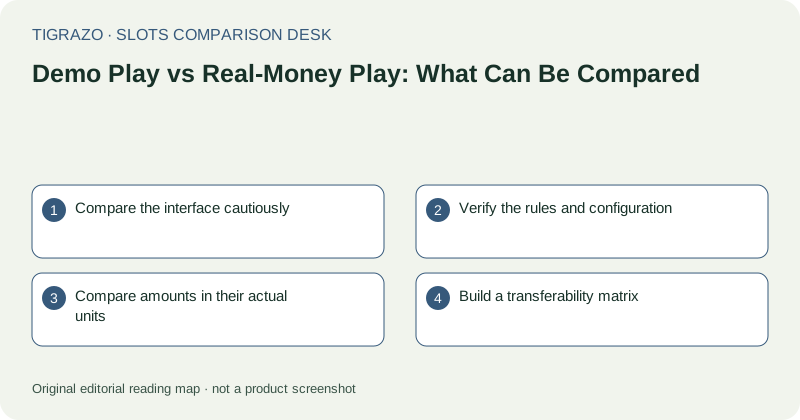
Compare the interface cautiously
Button placement, symbol readability and access to help can often be observed in a demonstration. Even here, confirm that the real-money version uses the same layout and device context. Similar artwork is not proof that every control or limit is identical.
A demo is useful for learning how information is presented. That learning does not establish account eligibility, payment behaviour or the handling of an actual financial settlement.
Verify the rules and configuration
Read the version, stake basis and mathematical configuration when documented. Demo conditions may differ, and a shared title does not resolve the question. If equivalence is not established, label it unknown rather than treating it as either confirmed or disproved.
Even documented identical mathematics would not make a short demo record predictive. Independent outcomes do not carry a pattern from a practice session into another session, and an unusually large demonstration award does not create a repeatable opportunity.
Compare amounts in their actual units
Hypothetical example: a demo begins with 10,000 credits and uses 100 credits per round. That is 100 starting stakes before considering awards. It says nothing about affordability until a real currency stake is identified, and the ease of resetting the demo balance has no financial equivalent.
Real-money losses affect actual resources. Fictional-credit losses do not reproduce that consequence or necessarily the emotional response to it. Familiarity with controls should not be confused with a realistic assessment of financial risk.
Build a transferability matrix
| Observation | Potentially transferable? | Required check |
|---|---|---|
| Symbol explanation | Sometimes | Same rule version |
| Control layout | Sometimes | Same interface context |
| Short-run awards | Not predictive | No sample-based promise |
| Balance reset | No financial equivalent | Recognise fictional funds |
| Settlement process | Not established by appearance | Relevant documentation |
This matrix does not rank the modes. It identifies which claims a demo can support and which require another source or remain unknown.
Keep the learning outcome bounded
Choose a concrete objective such as understanding a cascade or locating the stake label. Once that objective is achieved, the comparison can end. There is no necessary next step into real-money play.
- Are credits and currency separated?
- Is configuration equivalence documented?
- Are results being mistaken for forecasts?
- Which consequences cannot be simulated?
The most useful conclusion may be that the interface is clearer while the financial questions remain unanswered. That is a valid comparison result, not a failure to choose a mode.
A freely replenished balance can obscure repeated exposure, so record total stakes separately even when no actual money is involved.