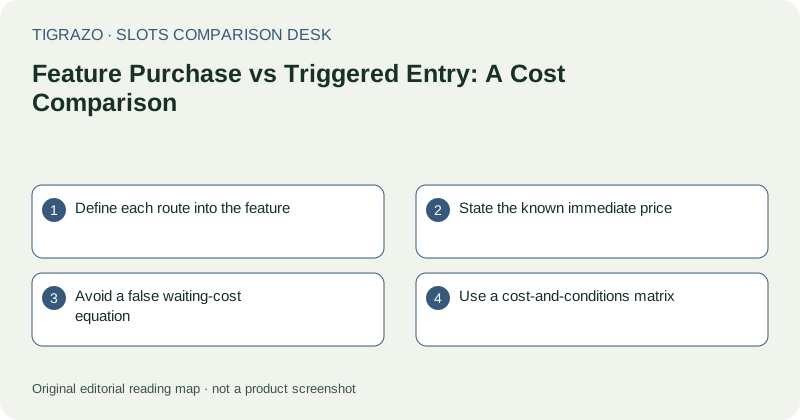
Define each route into the feature
Triggered entry follows the game's stated conditions during eligible rounds. A feature purchase, where available, commits a specified amount directly to an entry route. Check whether both routes lead to the same feature configuration, starting actions and award rules.
The same feature name is not enough to establish equivalence. A purchased version might have different conditions, and an ordinary trigger can vary according to symbol counts or game state.
State the known immediate price
Hypothetical example: a purchase priced at 80 times a 0.50 base stake costs 40.00. That is the amount committed by the purchase under the assumed rule. It is not an estimate of the feature's award or a guarantee that any portion will return.
For ordinary play, the known immediate price is the next eligible round's total stake. The eventual amount staked before entry is uncertain unless a specific guaranteed mechanism establishes otherwise.
Avoid a false waiting-cost equation
If a hypothetical independent trigger probability is one in 100 eligible rounds, its expected waiting count is 100 rounds. At 0.50 per round, the corresponding expected wager volume is 50.00 under those simplified assumptions. It is not a maximum wait, an appointment or the expected net loss.
Ordinary rounds may award money along the way. Comparing their gross wager volume directly with a purchase price leaves those awards, distribution differences and potentially different rules unaccounted for. The calculation illustrates why the quantities cannot simply be treated as equivalent costs.
Use a cost-and-conditions matrix
| Dimension | Purchase | Triggered entry |
|---|---|---|
| Immediate commitment | Stated purchase price | Next round stake |
| Time to entry | Read purchase process | Conditional and uncertain |
| Intermediate awards | Not assumed | Possible under base rules |
| Feature equivalence | Must verify | Must verify |
Keep RTP and volatility questions separate unless equivalent documented configurations make a comparison meaningful. Do not invent a value score from the purchase multiple alone.
Make the decision informational
The useful output is a list of known commitments and unresolved differences. Neither route becomes advisable merely because its entry mechanism is easier to describe. Both can produce outcomes below the amount committed.
- Is the purchase total clear?
- Are feature rules genuinely equivalent?
- Has wager volume been confused with net cost?
- Has an average wait become a promise?
A spending boundary remains independent of the comparison. Understanding the routes does not create a need to take either one.
If a purchase confirmation shows a different stake basis from the main screen, pause the comparison until that discrepancy is understood.