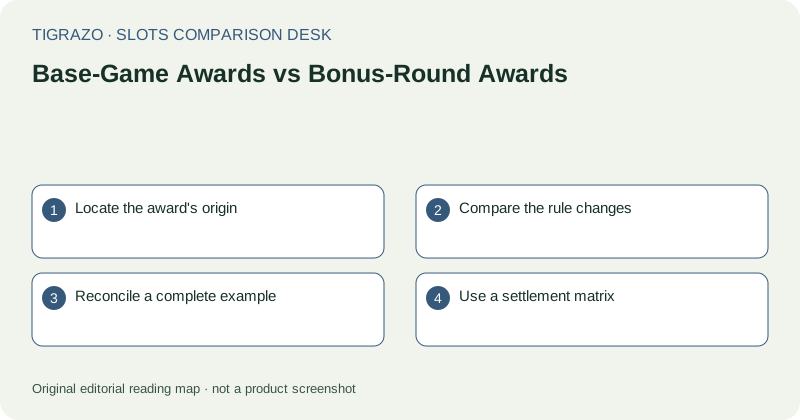
Locate the award's origin
A base-game award arises under the ordinary round's stated rules. A bonus-round award arises within a feature or special sequence. The trigger itself may also produce a direct award, so feature entry and feature payment should not be collapsed into one label.
Some interfaces group several stages under one round record. Others display intermediate totals. Read the accounting convention before deciding that every visible number represents a separate credit.
Compare the rule changes
A feature may alter symbols, multipliers, reel behaviour or available actions. It may also retain much of the base-game logic. The word bonus does not establish which rules change, whether a minimum award exists or whether the outcome will exceed the triggering stake.
Check the entry cost and conditions separately. A naturally triggered feature follows one route into the sequence; a purchase, if offered, may involve a separate cost and potentially different conditions.
Reconcile a complete example
Hypothetical example: a paid round costs 1.00, pays 0.50 in the base stage and leads to a feature whose accumulated award is 4.00. If those amounts are separate, the gross award is 4.50 and the net result is a gain of 3.50.
If the final displayed total of 4.50 already includes the 0.50, adding that base award again would be incorrect. The record's definition of total determines the calculation, not the number of celebratory screens.
Use a settlement matrix
| Dimension | Base stage | Feature stage |
|---|---|---|
| Qualification | Ordinary award rules | Feature-specific rules |
| Cost basis | Total paid stake | Read entry conditions |
| Displayed amount | May be separate or included | May be running or final |
| Settlement check | Round history | Round or feature history |
The matrix is an audit aid, not a ranking. A feature's visually larger award can still be uncommon, and comparing award size alone leaves its contribution to expected return unknown.
Choose the next reading task
If qualification is confusing, read the relevant stage's rules. If totals are confusing, inspect settlement definitions and recorded history. Replaying rounds is not a dependable way to resolve an accounting question.
- Does the trigger pay separately?
- Which amount is cumulative?
- Are intermediate figures already included?
- Does a maximum apply to the combined result?
Keep base and feature columns separate until the relationship is established. Their distinction should improve understanding of the complete round, not create an assumption that one stage is inherently more valuable.
Also check whether an interrupted feature's final record consolidates its earlier stages. That accounting detail can explain apparent discrepancies between screens.