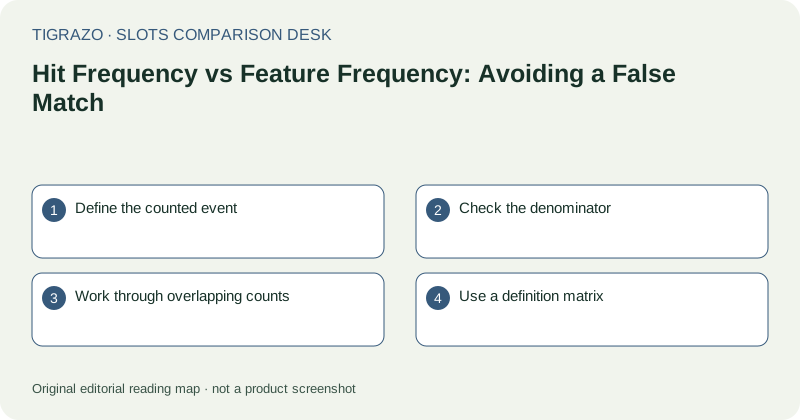
Define the counted event
Hit frequency commonly describes the share of rounds that produce a qualifying award, but the definition needs checking. Some presentations count any credited amount, including an award smaller than the stake. Others may use a different convention.
Feature frequency concerns entry to a specified feature. A feature may begin without a separate immediate award, while an ordinary paying combination may occur without any feature. The event names therefore identify different sets of outcomes.
Check the denominator
Ask whether the rate applies to paid base rounds, all actions including feature spins, or another defined population. A figure based on feature actions cannot be compared directly with a figure based only on paid entry rounds.
Also distinguish theoretical rates from an observed sample. A short recorded sequence describes that sequence only. It does not establish the configured probability, especially when the event is uncommon or when the counting convention is unclear.
Work through overlapping counts
Hypothetical example: among 100 recorded paid rounds, 24 produce an immediate award, four trigger a feature and two belong to both groups. Under those definitions, the observed award share is 24% and observed feature-entry share is 4%. The share containing either event is 26%, not 28%, because the overlap must be counted once.
This arithmetic describes the hypothetical record, not a theoretical prediction. It also says nothing about profitability: the sizes of stakes and awards have not been supplied.
Use a definition matrix
| Dimension | Hit frequency | Feature frequency |
|---|---|---|
| Event | Defined award outcome | Defined feature entry |
| May overlap? | Yes | Yes |
| Implies net gain? | Not necessarily | Not necessarily |
| Needs denominator? | Yes | Yes |
Record any unavailable definition as unknown. A percentage without its event and denominator is not ready for comparison, no matter how precisely it is printed.
Reject the due-feature inference
A long gap in a sequence does not make an independent feature trigger due. If a game has a documented persistent-state mechanism, read that mechanism separately; do not assume it from an observed dry spell.
- What event is counted?
- Can an award be below the stake?
- Which actions form the denominator?
- Are overlapping events counted correctly?
The practical decision is whether the two rates answer your actual question. When one describes any award and the other describes feature entry, presenting them as interchangeable measures hides more than it explains.
A retrigger rate inside an existing feature is another distinct measure. Keep it separate from the rate of initial entry during paid base rounds.