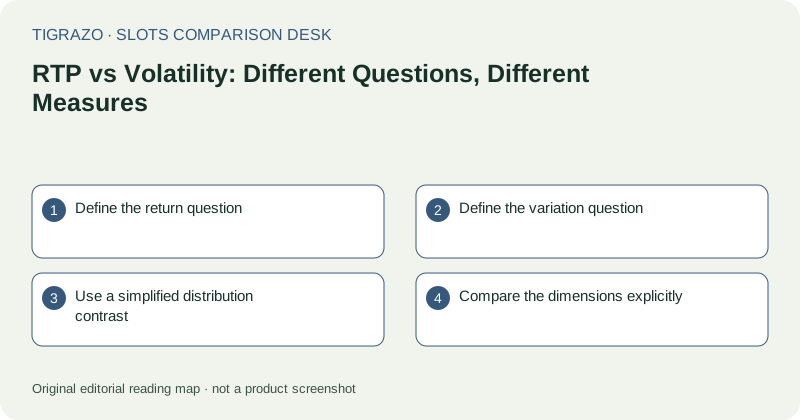
Define the return question
RTP expresses theoretical expected awards as a proportion of total amounts wagered under a specified mathematical configuration. It is not a promise that an individual receives that percentage back, and it is not a percentage of deposits automatically refunded.
Hypothetical example: a 96% RTP configuration has an expected award amount of 96.00 per 100.00 of wager volume in the theoretical long-run model. The corresponding expected net cost is 4.00, but actual short-run outcomes can differ substantially.
Define the variation question
Volatility concerns how widely results vary and how return is distributed among outcomes. A game may concentrate return in less frequent larger awards or distribute more of it among smaller awards. Informal low, medium and high labels may not use a consistent scale across sources.
RTP alone does not reveal that distribution. Two models can have the same average while producing very different experiences, and neither pattern makes future independent results compensate for past outcomes.
Use a simplified distribution contrast
Hypothetical example: model A returns 0.96 on every 1.00 trial. Model B returns 9.60 on 10% of trials and zero otherwise. Both have an expected award of 0.96 per trial, but model B has far greater variation. These are teaching models, not descriptions of actual slot products.
The example isolates the distinction cleanly. It does not imply that real games use only two outcomes, that volatility can be inferred from one observed win, or that a particular session will resemble the theoretical average.
Compare the dimensions explicitly
| Question | RTP | Volatility |
|---|---|---|
| Primary subject | Expected return ratio | Variation in outcomes |
| Short-session promise? | No | No |
| Comparable label? | Only matching configurations | Only matching definitions |
| Predicts next spin? | No | No |
Keep the exact version beside any percentage or category. A familiar title can exist with different mathematical configurations, so a number detached from its version is incomplete comparison data.
Choose the missing question
If you want to understand long-run expected cost, inspect RTP and stake assumptions. If you want to understand possible swings, inspect a supported distribution description and its limits. Neither measure establishes that a game is suitable for someone's circumstances.
- Is the RTP configuration identified?
- Is volatility formally measured or informally labelled?
- Are wager volume and deposits separated?
- Has either measure been turned into a session forecast?
A useful comparison preserves both dimensions instead of combining them into an invented overall quality score.
When a volatility scale is undocumented, preserve its original wording and avoid translating it into a supposedly equivalent numerical measure.