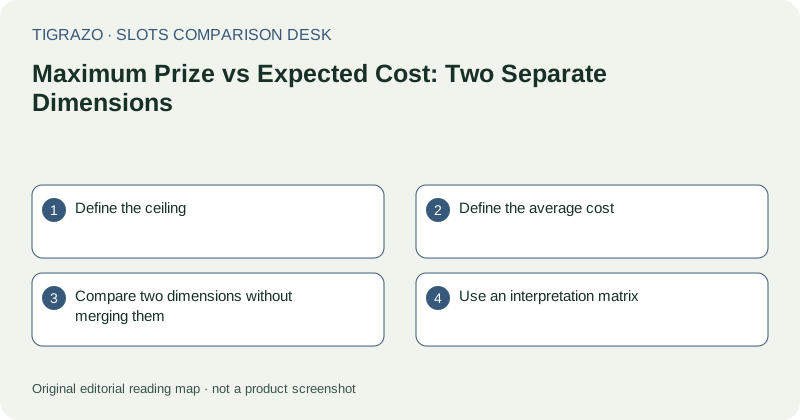
Define the ceiling
A maximum prize may be stated as a currency amount, a stake multiple or a cap on a combined sequence. Read its basis and eligibility conditions. The number says what the rules permit at the top end, not how often that result occurs.
A ceiling can also affect settlement by ending or limiting a sequence. That operational detail belongs in the rules comparison, but it still does not establish the probability of reaching the ceiling.
Define the average cost
For a specified RTP, theoretical expected net cost equals wager volume multiplied by one minus RTP. This is a long-run expectation under the mathematical model, not a session invoice and not a guarantee that any individual's results will approach it within a convenient period.
Hypothetical example: with 95% RTP and 200.00 of wager volume, expected gross awards are 190.00 and expected net cost is 10.00. Actual awards over a short sequence can be much lower or higher.
Compare two dimensions without merging them
Hypothetical example: a maximum of 5,000 times a 0.20 total stake equals 1,000.00. That figure cannot be divided into the 10.00 expected cost above to create a meaningful value score. The two quantities describe different aspects of a distribution, and the probability of the maximum remains unspecified.
Two games could share an RTP while having different maximum prizes and very different award distributions. Conversely, identical ceilings could coexist with different RTP configurations. No single headline resolves those relationships.
Use an interpretation matrix
| Dimension | Maximum prize | Expected cost |
|---|---|---|
| What it describes | Upper permitted award | Long-run average net amount |
| Needs stake basis? | Yes for multipliers | Yes through wager volume |
| Predicts a session? | No | No |
| Reveals full distribution? | No | No |
Use the matrix to keep claims modest. If a maximum is known but RTP is not, the expected-cost field remains unknown rather than being estimated from visual excitement or award size.
Choose an appropriate conclusion
A comparison can report that one ceiling is higher while refusing a best-game verdict. It can also explain a difference in expected cost without implying that the higher-return configuration prevents substantial losses.
- Is the maximum conditional?
- Is RTP tied to a specific version?
- Is wager volume distinct from deposit size?
- Are both values kept separate from affordability?
The useful decision is whether the numbers answer the question being asked. Neither a large possibility nor a long-run average should override a concrete spending boundary.