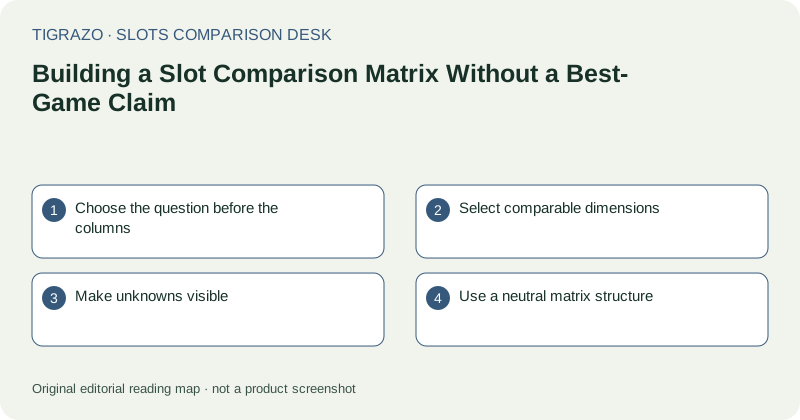
Choose the question before the columns
Begin with a narrow comparison purpose. You might compare award qualification, total costs or accessibility of rule information. A matrix intended to do all three without separation can accumulate many cells while answering no clear question.
Do not begin with an overall score and work backwards. That approach encourages arbitrary weights and creates an appearance of precision unsupported by the underlying evidence. Descriptive fields can remain useful without being converted into points.
Select comparable dimensions
Use the same definition for each row. Total round stake must mean the complete cost under the stated configuration. RTP must refer to the identified version. A feature count should not mix available feature types with the number of times a feature appeared in a short observation.
Hypothetical example: one entry lists a 0.02 line stake and another lists a 0.40 total stake. Those values cannot share a minimum cost row until the first entry's active-line configuration and total are established.
Make unknowns visible
Use plain labels such as not stated, not verified or not applicable. These mean different things and should not all become zero. Zero is a numeric value; an unknown RTP or award probability is missing information, not a measured absence.
Keep the provenance of each field in your working notes without inventing authority. A figure copied from another configuration should not silently become evidence for the version being compared.
Use a neutral matrix structure
| Dimension | Entry A | Entry B | Interpretation |
|---|---|---|---|
| Award system | Record rule | Record rule | Different logic, not rank |
| Total cost | Same currency basis | Same currency basis | Match configurations |
| RTP | Version-specific | Version-specific | Long-run expectation |
| Rule readability | Concrete observation | Concrete observation | Context-dependent |
The labels Entry A and Entry B illustrate a method; they do not name actual products. Populate them only with information actually established for the items under discussion.
Write a bounded conclusion
Summarise two or three meaningful differences and the uncertainties that limit interpretation. If personal preferences matter, name them explicitly rather than disguising them as universal quality. Readability and theme interest are not mathematical advantages.
- Does every row answer the stated question?
- Are units and configurations aligned?
- Are unknowns preserved?
- Are observations separated from preferences?
A strong matrix may conclude that there is insufficient information for a broader judgement. It may also show that neither option meets a reader's needs. Those are useful outcomes, and neither requires a best-game claim or a recommendation to gamble.