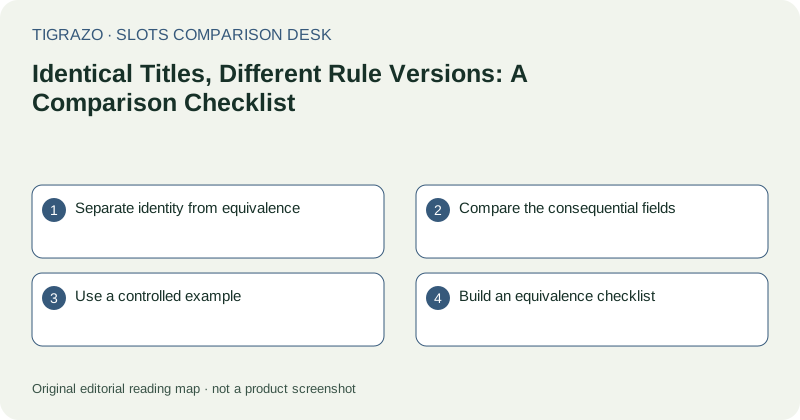
Separate identity from equivalence
Record the title exactly, then look for version identifiers, help-text details and configuration information. These fields answer different questions. A title identifies a product family; a configuration describes the particular rules and mathematics currently in use.
Do not assume a difference either. The appropriate conclusion can be equivalent on documented fields, different on documented fields or unresolved. Familiar branding cannot prove sameness, but uncertainty does not prove a hidden change.
Compare the consequential fields
Start with total stake basis, paytable values, matching rules, wild and scatter roles, feature-entry conditions and maximum awards. Add RTP configuration when stated. Read optional modes separately because a switch can alter cost or eligibility without changing the title.
A small wording difference may matter more than a large visual redesign. Conversely, different interface artwork may leave the underlying rules unchanged. Comparison should follow consequential conditions, not cosmetic resemblance.
Use a controlled example
Hypothetical example: version A lists a particular award as 20 times a line stake, while version B lists 20 times total stake. Even though the multiplier matches, the currency meaning may differ. The correct first task is verifying each base, not declaring the paytables identical.
Another hypothetical pair states RTP values of 96% and 94%. Per 100.00 wagered, their theoretical expected net costs are 4.00 and 6.00 respectively. These calculations describe long-run expectations under their configurations, not predicted session losses.
Build an equivalence checklist
| Field | Version A | Version B | Status |
|---|---|---|---|
| Stake basis | Record wording | Record wording | Match, differ or unknown |
| RTP configuration | Record if stated | Record if stated | Do not infer |
| Feature entry | Record conditions | Record conditions | Check exceptions |
| Maximum award | Record basis | Record basis | Compare units |
Attach a date or context to your own notes when useful, but do not manufacture a release history. The checklist is a snapshot of documented information.
Transfer only what is established
If symbol rules match but RTP remains unknown, transfer only the symbol explanation. If an old note lacks its configuration, mark it incomplete before reusing it. Partial equivalence is a meaningful result.
- Is each figure attached to a version?
- Are stake units consistent?
- Are optional modes separated?
- Are unknowns still visible?
This approach produces a defensible comparison without claiming that one title label guarantees one immutable set of rules across every context.
Where wording changes between languages, compare the complete condition rather than isolated terms. Translation differences can create apparent contradictions that the full rule resolves.